When planning a commercial network, choosing between coax vs fiber cabling is one of the first engineering decisions — and one of the most consequential. The cable you install today will be in your walls, ceilings, and conduits for the next 10 to 25 years, carrying every bit of voice, video, data, and security traffic your business generates. This guide compares coaxial cable and fiber optic cable across bandwidth, distance, cost, interference, and long-term total cost of ownership so you can make the right choice for your environment — and avoid the expensive mistake of picking the wrong medium and having to re-cable.
Quick answer:
For virtually all new commercial installations, fiber optic wins — unrestricted bandwidth, unlimited distance, total immunity to EMI, and a 25+ year lifespan. Coaxial cable is still useful for specific legacy use cases (CATV, analog security cameras, older video surveillance systems, some broadcast applications) but shouldn't be the backbone of a new data network in 2026. Most commercial buildings today deploy a hybrid structured cabling system — fiber for backbone runs between floors and buildings, plus Cat6A copper for horizontal drops to workstations and Wi-Fi access points.
What Is Coaxial Cable?
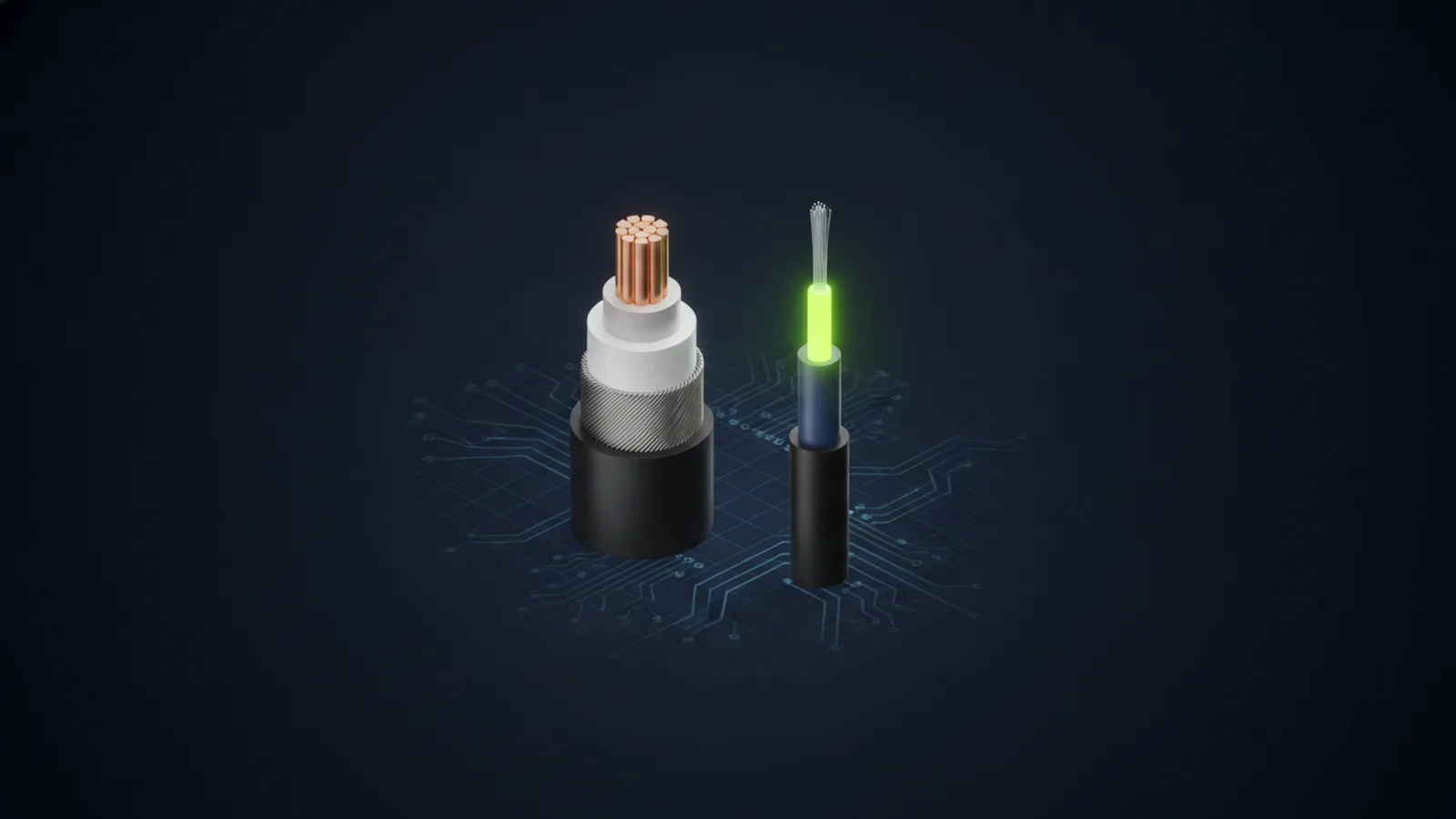
Coaxial cable ("coax") is a copper transmission medium consisting of a solid or stranded copper core, surrounded by a layer of insulating dielectric, wrapped in a metallic shield (either braided copper or aluminum foil), and finished with an outer jacket. The "coaxial" name comes from the fact that the inner conductor and outer shield share the same central axis. This geometry is what gives coax its strong noise immunity compared to untwisted copper — the shield forms a Faraday cage around the signal-carrying core.
Coax was the backbone of television distribution, early internet service (cable modems), and analog security camera systems for decades. Common commercial variants include RG-6 (used for CATV and satellite distribution), RG-11 (for longer runs with less signal loss), and RG-59 (legacy analog CCTV). RG-6 is still widely deployed for cable TV and for connecting coax-based security systems.
What Is Fiber Optic Cable?
Fiber optic cable transmits data as pulses of light through thin strands of glass (or, less commonly, plastic). Each strand — the "fiber" — consists of a transparent core, surrounded by a cladding layer with a slightly different refractive index that traps light within the core via total internal reflection. A buffer coating protects the fiber physically, multiple fibers are bundled into a protective jacket, and the whole assembly is typically armored with a strength member.
Fiber comes in two families: single-mode fiber (SMF), which uses a very small core (8-10 microns) for long-distance runs up to 40km+ at speeds of 10G, 40G, 100G, 400G, or more; and multi-mode fiber (MMF), which uses a larger core (50-62.5 microns) for shorter runs up to 2km at similar speeds using more affordable optical transceivers. Most commercial buildings install single-mode for backbone runs between buildings and multi-mode (OM4 or OM5) for shorter intra-building backbone and data center use. For a deeper dive, see our single-mode vs multi-mode fiber comparison.
Coax vs Fiber: Side-by-Side Comparison
Here's how the two cable types compare across the dimensions that matter most for commercial network design:
| Dimension | Coaxial Cable (RG-6 / RG-11) | Fiber Optic Cable (SMF / MMF) |
|---|---|---|
| Maximum bandwidth | ~1 Gbps typical (up to ~10 Gbps with DOCSIS 4.0 on last-mile cable) | 100+ Gbps per strand today; petabit-scale in research labs |
| Maximum distance | ~100-500 meters before signal boosters required (RG-6), up to ~1000m for RG-11 at lower bandwidth | 40km+ for single-mode, 300-550m for OM3/OM4 multi-mode at 10G, 2km at 1G |
| Immunity to EMI / RFI | Good (shielded) but still susceptible to strong electromagnetic interference | Total immunity — light is unaffected by EMI, RFI, or lightning-induced surges |
| Signal loss over distance | High — significant signal loss beyond ~100m, requires amplifiers | Very low — 0.2 dB/km for SMF; runs kilometers without amplification |
| Physical durability | Flexible, tolerant of rough handling; bend radius ~10x cable diameter | Glass is brittle; requires careful handling; bend radius 10-20x cable diameter; armored variants available |
| Installation cost (per foot) | $0.30 - $1.50 (cable); lower tooling/termination cost | $0.50 - $3.00 (cable); higher tooling cost (fusion splicer ~$3,000-$30,000) |
| Termination complexity | Low — compression connectors, no specialized training beyond basics | Higher — requires fusion splicing or pre-terminated assemblies; trained technicians |
| Security | Signal can be tapped with relatively simple equipment | Very difficult to tap without detection — physical intrusion breaks the light path |
| Expected lifespan | 15-20 years in typical commercial environments | 25+ years when properly installed; bandwidth upgrades done via replacing transceivers, not cable |
| Weight / cable diameter | Heavier; larger diameter; limited pathway density | Lighter; smaller diameter; higher pathway density |
| Standard governing body | ANSI/SCTE for CATV; no unified structured cabling standard for data | TIA/EIA-568, ISO/IEC 11801 for structured cabling |
When to Use Coax
Despite fiber's advantages, coax still has legitimate commercial use cases in 2026:
- CATV and satellite distribution: RG-6 is the standard for distributing cable and satellite TV to hotel rooms, hospital rooms, break rooms, and multi-tenant buildings. Fiber is not cost-effective here because each TV already has an RF-based tuner.
- Last-mile internet from cable ISPs: Many commercial buildings still receive internet service from a cable ISP via coax (RG-6 or RG-11) running from a pedestal to the building's demarcation point. The coax terminates at a cable modem that converts to Ethernet for internal distribution.
- Legacy analog security cameras: Older CCTV systems using analog cameras and DVR recorders still use RG-59 coax with BNC connectors. If you're retaining legacy cameras during a security upgrade, preserving the coax runs may be cheaper than re-cabling. For new installs, see our IP-based video surveillance services.
- Broadcast and A/V applications: Professional broadcast video (SDI, HD-SDI, 3G-SDI, 12G-SDI) still uses coaxial cable. Production studios, broadcast facilities, and some corporate A/V deployments continue to rely on coax for its deterministic latency and physical ruggedness.
- RF and radio frequency distribution: Two-way radio systems, distributed antenna systems (DAS), and cellular amplifier installations use coax because they carry RF signals, not digitized data.
When to Use Fiber Optic
Fiber optic cable is the right answer for virtually every modern commercial network backbone and any run longer than about 100 meters:
- Backbone cabling between buildings: Any inter-building run (campus backbone) should be single-mode fiber. Copper is limited to 100m between switches; fiber carries 40km+ and is immune to outdoor EMI and lightning-induced ground loops.
- Backbone between floors in a multi-story building: Vertical backbones connecting equipment rooms on each floor should be fiber (OM4 or OM5 multi-mode for sub-300m runs; single-mode for longer). This future-proofs the backbone beyond 10G speeds that copper cannot sustain.
- Data center interconnects: Spine-and-leaf data center architectures use fiber exclusively between switches. Short-reach MMF (OM4/OM5) dominates inside the data center; SMF handles DCI between geographically separate sites.
- High-bandwidth workstations: Creative studios, engineering CAD workstations, video editing suites, and scientific computing environments benefit from fiber-to-the-desk when 10G+ sustained throughput is required.
- High-EMI environments: Manufacturing floors, elevator shafts, utility corridors, and areas near large motors, generators, or radio transmitters should use fiber to avoid signal degradation from ambient EMI.
- Long horizontal runs exceeding copper's 100m limit: Warehouses, large manufacturing buildings, parking structures, and sprawling campuses have runs that exceed Cat6A's 100-meter cap. Fiber eliminates the need for intermediate closets and repeaters.
- Security-sensitive installations: Government, defense, financial services, and healthcare installations often mandate fiber for its tap-resistance. A fiber tap requires physically breaking the light path, which is immediately detectable.
Cost Comparison — Coax vs Fiber in Practice
Cable itself is usually a small fraction of a structured cabling project cost. Labor, pathways (conduit, cable tray, J-hooks), terminations, testing, and certification typically dominate. That said, here's how the all-in costs typically compare for a commercial installation:
| Cost component | Coaxial (RG-6 typical) | Fiber (SMF / OM4 MMF) |
|---|---|---|
| Cable, per foot | $0.30 - $1.50 | $0.50 - $3.00 |
| Termination per end | $5 - $15 (compression connector) | $25 - $75 (fusion splice) or $15-40 (pre-terminated assembly) |
| Test equipment | ~$500 (basic RF tester) | $3,000 - $30,000 (OTDR + power meter + fusion splicer) |
| Installer training / certification | Minimal (most electricians can terminate coax) | Significant (BICSI, manufacturer-specific fusion splicer certifications) |
| Lifecycle cost over 20 years | Higher (capacity upgrade typically requires re-cabling) | Lower (bandwidth upgraded by replacing $500-$3,000 optical transceivers, not cable) |
The cost equation often surprises people. Fiber's higher per-foot and per-termination cost is offset — usually many times over — by its 25+ year usable life and the ability to upgrade speeds without re-cabling. A commercial building that installed single-mode fiber in 2005 for 1G can today support 400G on the exact same strands just by replacing the switch transceivers.
Is Coax Being Phased Out?
Not entirely — but for new data network installations, yes. The telecommunications industry has been migrating away from coax for backhaul and distribution since the early 2000s. Cable ISPs are deploying fiber-to-the-premises (FTTP) in both residential and commercial markets to replace the legacy HFC (hybrid fiber-coax) plant. Industry analysts expect most commercial buildings in Tier-1 metros (including Phoenix and Tucson) to have fiber service available from multiple carriers by 2030.
That said, coax won't disappear overnight. Its continued relevance in CATV distribution, legacy CCTV, broadcast video, and RF applications means commercial buildings will continue to have some coax infrastructure for the foreseeable future. What's changing is the role: coax is becoming a last-mile and specialty medium, while fiber is becoming the default for everything else.
Choosing the Right Cabling for Your Arizona Business
For most Arizona commercial buildings — offices, warehouses, medical facilities, schools, industrial sites — the answer in 2026 looks like this:
- Fiber optic cable for all inter-building and inter-floor backbone runs, plus any horizontal run longer than 100 meters.
- Cat6A copper cabling for horizontal drops to workstations, conference rooms, and wireless access points (supporting 10G Ethernet to 100m and Wi-Fi 6E / Wi-Fi 7 access points).
- RG-6 coaxial cable only where specifically required — TV distribution, cable modem termination, legacy analog systems, or RF/DAS applications.
Unió Digital is a licensed Arizona structured cabling contractor (ROC 327245, ROC 333580) specializing in this hybrid approach. We design, install, and certify cabling systems across Tucson, Phoenix, Scottsdale, Mesa, and the broader Arizona market. Every installation includes LanTEK IV certification and a 25-year manufacturer warranty on copper and fiber components.
For related reading, see our comparisons of Cat6 vs Cat6A, fiber vs copper cabling, and single-mode vs multi-mode fiber, or explore our structured cabling services and fiber optic installation services.
Ready to Design Your Cabling Project?
Unió Digital provides free on-site cabling assessments, fixed-price project quotes, and licensed Arizona ROC installation across Tucson, Phoenix, and the Arizona market. Fiber, copper, or hybrid — we deliver certified results that last 25+ years.
Request a Cabling Assessment