A Tucson business shopping for access control in 2026 is really making one decision first: cloud-based or on-premise. Everything else, credential type, door hardware, camera integration, follows from that. Cloud-based platforms like Avigilon Alta have become the default for small and mid-size buildings because there is no on-site server to maintain and doors can be managed from a phone or browser. The right fit for your business comes down to door count, whether you already have cameras installed, and how often you add or remove employees. This guide walks through the choices in the order you'll actually face them, plus what a Tucson installation involves and how to pick an installer.
Cloud vs. On-Premise: The First Decision
On-premise access control puts a physical panel and server somewhere in your building, usually a network closet, that stores credentials and access rules locally. It works, but someone has to patch it, back it up, and physically be on-site to make most changes. Cloud-based systems, Avigilon Alta is the platform Unió Digital installs, move that management to a web portal and mobile app. You add a new hire, revoke a departing employee's badge, or check who came in after hours from anywhere, without a site visit. For most Tucson small businesses, especially single-location offices, warehouses, and retail spaces, cloud-based is the more practical choice: lower up-front hardware cost, no server to maintain, and faster changes. On-premise still makes sense for a small number of use cases, mainly larger campuses with dedicated IT staff and a preference for keeping everything off the internet entirely.
Credential Options: Keycard, Mobile, and Biometric
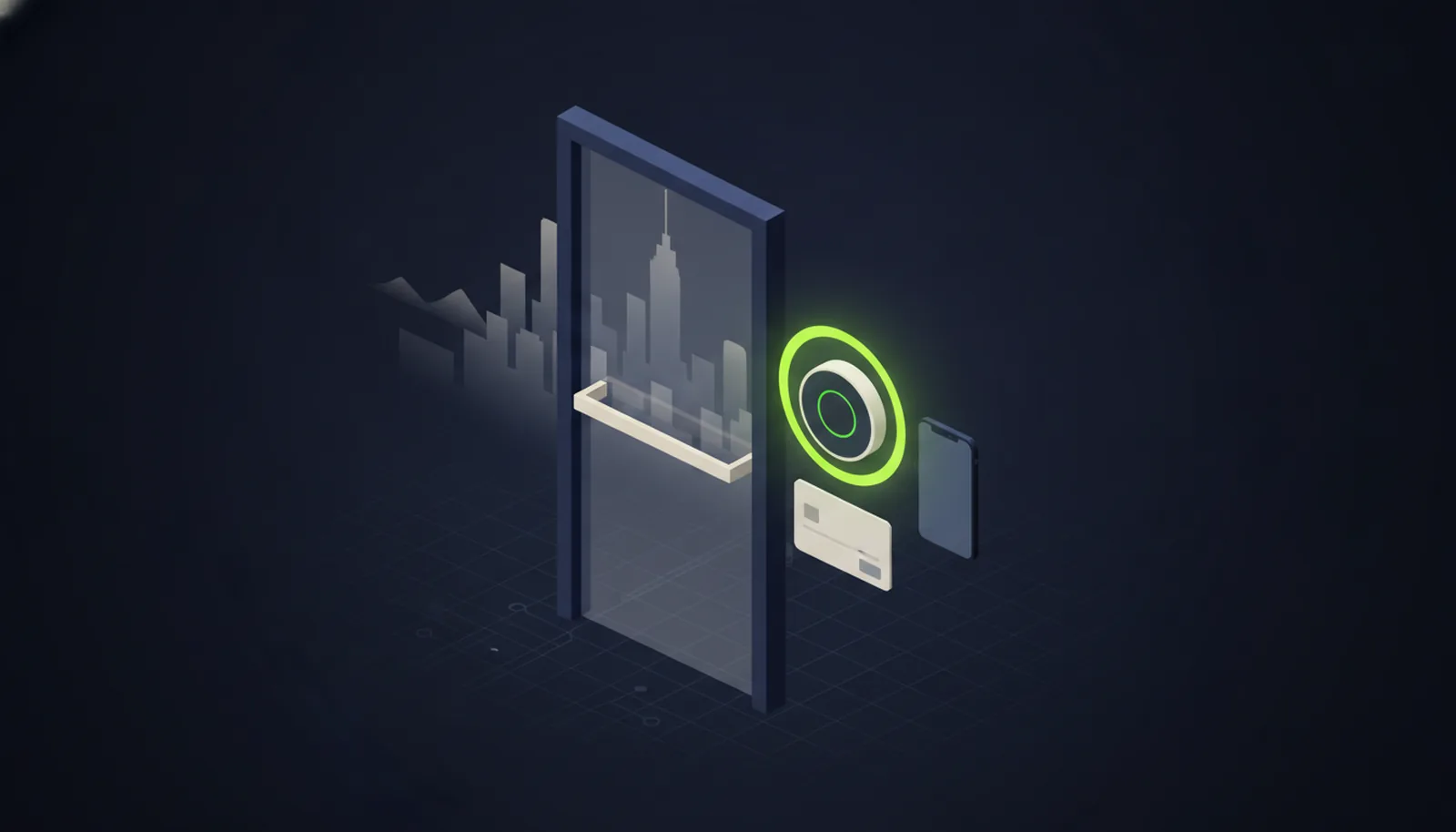
Once you've picked an architecture, the next decision is how employees actually get through the door. Each option trades cost, convenience, and security differently.
| Credential type | How it works | Best fit |
|---|---|---|
| Keycard / fob | Employee taps or swipes a physical card or key fob at a reader. | Simple deployments, businesses that already issue ID badges |
| Mobile credential | A smartphone app or Bluetooth/NFC signal opens the door, no physical card to lose or clone. | Businesses that want faster onboarding and fewer lost-badge support calls |
| Biometric | Fingerprint or facial recognition confirms identity at the door. | Higher-security areas: server rooms, records storage, controlled-substance or evidence rooms |
Most Tucson buildings we install for end up running a mix: mobile or card credentials at the main entrance and general office doors, with biometric or a second factor reserved for a server room or a records area. You are not locked into one credential type for the whole building.
Door Hardware: What's Actually on the Door
The reader is the visible part, but the hardware behind the door is what actually secures it. An electric strike releases the existing door latch electronically and is the common retrofit choice because it works with hardware already in place. A magnetic lock holds the door shut with an electromagnet and a strike plate, and is more common on glass doors or where a strike isn't practical. Every door also needs a request-to-exit (REX) sensor or button so people can leave freely, and a door position switch so the system knows whether a door is open, closed, or propped. Fire and life-safety code requirements govern how these fail (most commercial doors must fail unlocked in a power outage or fire alarm event), so this is not a place to guess; a licensed installer scopes this per door during the site survey.
Integrating Access Control with Video Surveillance
Access control and video work better together than as separate systems. On the Avigilon Alta platform, a door event, badge-in, forced door, door held open, can pull up the matching camera clip automatically, so you're not cross-referencing two different logs after an incident. If you already have security cameras installed in Tucson, adding access control on the same platform is usually a straightforward integration rather than a rebuild. See our video surveillance services for how the camera side works.
What Installation Involves in a Tucson Building
A typical project starts with a site survey: door count, existing hardware, wall and door material, and where low-voltage cable can run to reach each reader. Retrofitting an existing door is usually straightforward; a storefront or glass door, a fire-rated door, or a door tied into your fire alarm system takes more planning. Commercial access control and alarm work in Pima County generally requires a permit through the county or city building department depending on your location, and a licensed installer pulls that permit as part of the project rather than leaving it to you. Check current requirements with Pima County Development Services before you assume a small job is exempt. Most single-location installs of a handful of doors are completed in a day or two once the survey and any permitting are done; larger multi-door or multi-building projects run longer.
What Drives the Cost
We're not going to hand you a number that doesn't hold up once a surveyor sees your building, so here is what actually moves an access control quote: door count is the biggest factor, since each door needs its own reader, hardware, and wiring run. Retrofit vs. new construction matters too: pulling cable through a finished wall costs more labor than an open ceiling during a build-out. Credential type changes per-reader hardware cost, biometric readers cost more than card readers. And most cloud-based platforms carry an ongoing subscription per door on top of the installed hardware, which is worth budgeting as an operating cost, not a one-time expense. Ask any installer for a per-door breakdown, not just a project total, so you can see which line items are driving the price.
Choosing a Local Installer vs. a National Vendor
A national access control vendor can sell you hardware, but day two, the site visit when a reader stops responding or a new tenant needs a badge fast, usually goes through a call center and a ticket queue. A local, licensed installer answers the phone, already has your building's wiring documented, and can be on-site the same week. In Arizona, confirm the installer holds an Alarm License (issued by the Arizona Department of Public Safety) for access control and intrusion work, not just a general contracting license. Ask how they handle emergency lockouts, how fast they can add a door to an existing system, and whether they support the platform you're already on if you're expanding rather than starting fresh.
Why Unió Digital
Unió Digital is an Arizona-licensed alarm contractor (Alarm License 25254-0) and ROC-licensed low-voltage contractor (ROC 327245, ROC 333580), headquartered in Tucson and serving Southern Arizona since 2016. We install and support Avigilon Alta cloud-based access control, integrated with the same Avigilon and Rhombus camera platforms we install for video surveillance, so door events and footage live in one system instead of two. If you're comparing platforms before you commit, our Openpath vs. Brivo comparison walks through how two of the other cloud-based options stack up. For local scope, response and pricing, start with our access control in Tucson service page.
Frequently Asked Questions
What is the best access control system for a small business?
For most small businesses, a cloud-based system like Avigilon Alta with mobile or card credentials is the best starting point: no on-site server, fast changes from a phone, and it scales up to biometric or additional doors later without a platform change. The right choice still depends on door count, whether you need to integrate with existing cameras, and whether any area needs a higher-security credential like biometric.
Do I need a permit for commercial access control in Tucson?
Commercial access control and alarm work in Pima County generally requires a permit, and the specific requirement depends on your building, jurisdiction, and scope of work. A licensed installer pulls the permit as part of the project. Check current requirements with Pima County Development Services before assuming a small job is exempt.
Can access control integrate with my existing security cameras?
Yes. On a unified platform like Avigilon Alta, a door event can automatically pull up the matching camera clip, so you don't have to cross-reference two separate logs. If your cameras are already on Rhombus or Avigilon, adding access control is usually a straightforward integration rather than a system rebuild.
How long does an access control installation take?
A single-location install of a handful of doors is typically completed in a day or two once the site survey and any required permitting are done. Retrofitting an existing door with standard hardware is faster than a fire-rated door, a storefront glass door, or a multi-building project, all of which need more planning time before installation day.
Ready for an Access Control Quote in Tucson?
A site survey turns these options into a fixed-scope quote from an Arizona-licensed alarm contractor.
Get an Access Control Quote